How to Plan a Wholesale Printed Modal Hijab Collection
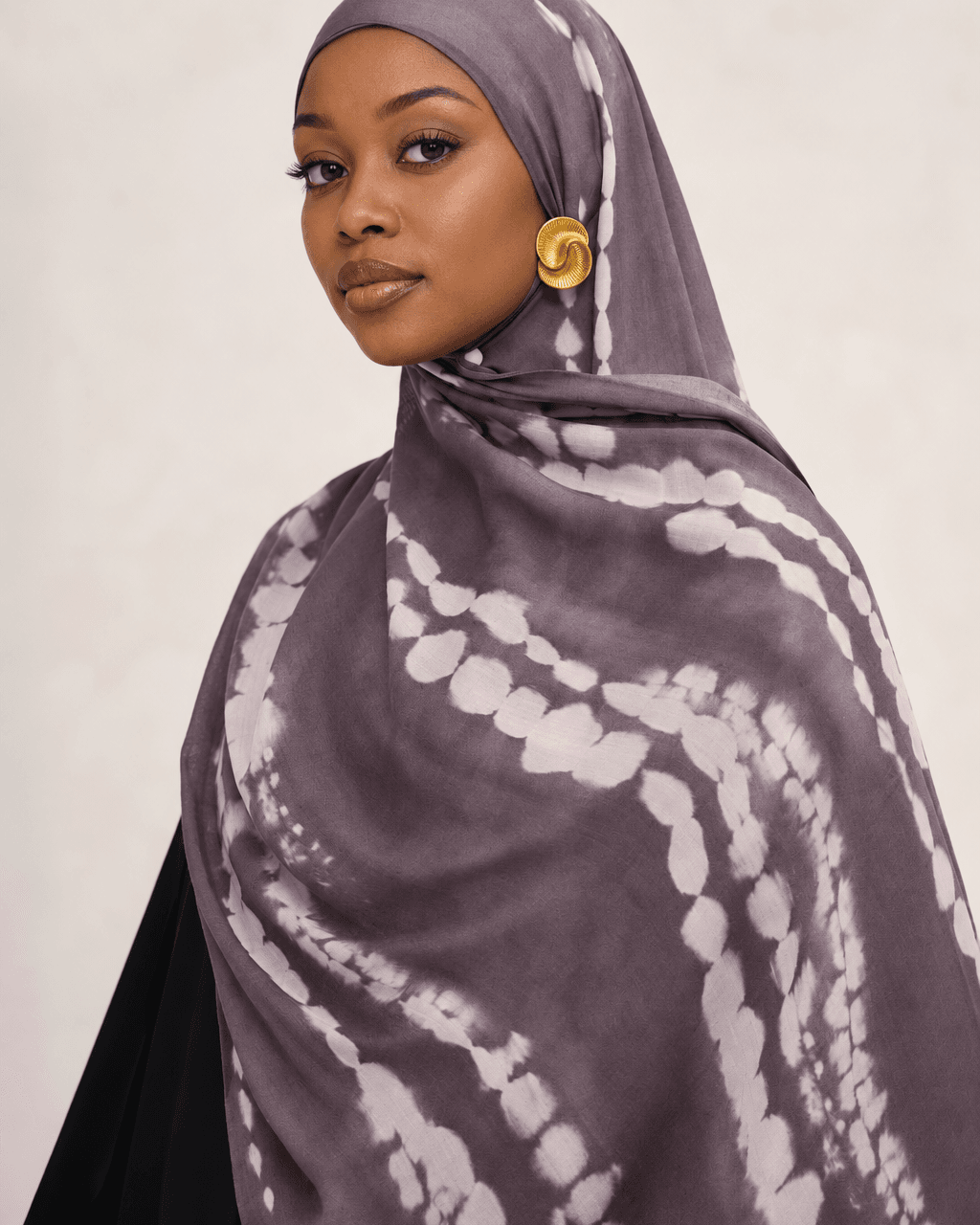
A printed modal hijab wholesale collection should be planned as a small, legible assortment: assign each pattern a customer and merchandising role, build coordinated color families, control the SKU count, allocate quantities by evidence and approve every design-color combination physically before bulk. The RFQ should show quantities by SKU rather than one total estimate.
Define the job of the printed modal hijab wholesale collection
Start with target customer, market, season or evergreen role, price positioning, channels and styling occasions. A boutique edit may need a tight story with visible differentiation, while a distributor may need broader color coverage. These decisions guide the brief but do not predetermine fabric performance, MOQ or price.
Write a one-line promise for the collection, then define exclusions. For example, a muted earth-tone capsule may exclude bright novelty colors; an everyday border story may avoid prints that only read in flat photography. Clear boundaries help teams reject attractive ideas that do not serve the assortment.
| Collection role | Purpose | Buyer question |
|---|---|---|
| Anchor print | Carries campaign identity | Is it recognizable flat and worn? |
| Commercial coordinate | Pairs easily with core wardrobes | Does it complement the anchor? |
| Novelty/test | Tests a new motif or palette | Is exposure limited appropriately? |
| Continuity option | Supports reorder or evergreen demand | Can identity and controls be retained? |
Build a pattern mix instead of isolated favorites
Review prints together at thumbnail, full-open and worn scale. Avoid a group in which every design has the same density, border structure or visual volume. A practical mix can contrast geometric, botanical and abstract directions while sharing enough palette or line character to look intentional.
Check intellectual-property status before investing in development. Use buyer-owned, commissioned or properly licensed artwork and retain records. Supplier service descriptions show that custom artwork is a common enquiry topic, but they do not transfer rights or guarantee that every concept is technically feasible.
Assign face-frame and tail behavior
For each design, mark what should appear around the face and what should remain legible in the tail. Border prints need orientation and corner decisions; all-over repeats need scale and crop review; engineered placements need a finished-product map.
Evaluate whether different styling methods preserve the design intent. A collection can intentionally include one statement border and one flexible all-over repeat, provided product copy explains their different strengths.
Organize color families and SKU architecture
Create a limited set of palette families—such as warm, cool and neutral—based on customer and sales evidence. Not every pattern needs every color. Give each combination a style-color code and test whether it adds a distinct merchandising option rather than a near duplicate.
SKU count equals the combinations the operation must sample, approve, photograph, label, forecast, store and reorder. Add packaging or region variants and complexity rises further. Calculate this before requesting a quote, then remove weak combinations while the collection is still inexpensive to change.
| Architecture decision | Planning record | Risk to control |
|---|---|---|
| Design count | Named styles and roles | Visual duplication |
| Colorway count | Palette family per style | Unnecessary SKU expansion |
| Variant coding | Unique style-color code | Sample/label mismatch |
| Channel/region | Packaging or compliance variant | Inventory fragmentation |
Allocate quantities without inventing demand
Start with available evidence: comparable sales, waitlists, retailer commitments, campaign testing or disciplined buyer judgment. Split the planned total by exact SKU and show the rationale. Protect more speculative designs with an appropriate test approach rather than giving every color an equal allocation for convenience.
Then ask the supplier to assess the preferred split against the actual fabric, print process and component constraints. MOQ may apply by fabric, artwork, colorway, label or packaging. Do not publish or assume a number from a general FAQ; compare alternatives such as fewer launch colors or shared packaging only after feasibility and brand needs are reviewed.
- Forecast source and confidence
- Quantity by style-color SKU
- Anchor versus test allocation
- Reorder intent and retained controls
- Supplier constraint by process/component
- Fallback assortment if a variant is infeasible
- Destination and channel breakdown
- Approval owner for changes
Sample the collection as a system
Material and artwork decisions can begin separately, but final approval must reconnect them. Review print strike-offs for color and definition, finished samples for scale, placement, dimensions and edges, and a complete pre-production submission for labels and packaging. Identify what each stage does not approve.
Lay every colorway together to catch unintended gaps or duplicates, then assess each one individually for opacity and wash behavior. Pale areas, dark fields and high-contrast borders present different risks. Keep identified controls and a consolidated comment file for each SKU; one approved colorway is not automatic approval for the rest.
| Gate | Collection-level check | SKU-level check |
|---|---|---|
| Artwork | Pattern mix and palette coherence | Rights, repeat, scale and placement |
| Strike-off | Colors work as a family | Definition and physical shade |
| Finished sample | Range reads consistently worn | Dimensions, border, opacity and edge |
| Pre-production | Packaging system is coherent | Correct code, label and approved revision |
Design labels and packaging around operations
A shared packaging structure can make a collection coherent, but every unit still needs reliable identification. Define brand and care labels, hangtags, barcode ownership, style-color code, fold, insert, bag or band, warning text where applicable, and carton assortment. Obtain qualified advice on destination-market content.
Test whether folds hide the selling motif, whether printed inserts transfer or rub, and whether barcode and color names match the approved SKU sheet. Keep sustainability or compliance claims specific and supported. Material composition, certification and testing details must not be printed until verified for the exact product.
- Style-color identifier on sample and pack
- Approved label wording and artwork revision
- Care instruction supported by validation
- Barcode ownership and scan check
- Fold that presents the intended motif
- Unit protection and snag/transfer review
- Carton assortment and lot marks
- Destination-market review
Send one complete, comparable RFQ
Provide business and market context, collection brief, artwork ownership status, fabric direction, provisional dimensions, SKU matrix, quantity per SKU, edge, labels, packaging, quality plan, destination and target schedule. Mark open fields clearly and ask the supplier to state assumptions, constraints and alternative routes.
Request project-specific confirmation of exact composition and construction, dimensions, MOQ, price, sample steps, production timing after approvals, test options and commercial terms. The Heritage Mosaic, Midnight Botanical and Earthwash pages offer three pattern-role references; use the artwork, sampling, opacity and wash guides to turn the selected direction into measurable approvals.
- Collection objective and target buyer
- Original/licensed artwork status
- Style-color SKU matrix
- Quantity by SKU—not total only
- Fabric and dimension confirmation fields
- Sampling and approval gates
- Labels, packaging and barcode plan
- Quality/test expectations
- Ship-to destination
- Questions on MOQ, price and timing
Launch with a reorder record
Archive approved artwork, physical samples, specifications, color references, wash records, labels and packaging files under the same codes used in the purchase order. Track sales and return reasons by SKU rather than only at collection level.
For a reorder, ask whether material, process or components changed and repeat risk-based approvals when necessary. Good records make the second order safer; they do not eliminate physical verification or replace market-specific advice.
FREQUENTLY ASKED
Buyer FAQ
How many designs should a printed modal hijab wholesale collection include?
There is no universal number. Choose the smallest assortment that covers distinct customer and merchandising roles while remaining practical to sample, approve, stock and market.
Should every print come in every color family?
Usually not. Add a colorway only when it creates a meaningful choice and can be supported operationally. Each combination needs its own code and physical approval.
How should wholesale quantities be split between SKUs?
Use comparable sales, buyer commitments, demand signals and risk judgment, then show a quantity by SKU. Ask the supplier to confirm process minimums and workable alternatives.
What information belongs in a printed modal collection RFQ?
Include target market, artwork status, fabric direction, dimensions, SKU/colorway matrix, quantity by SKU, edges, labels, packaging, quality expectations, destination and schedule for feasibility review.
Related buyer resources
Research basis
This guide converts recurring public consumer questions, review themes and supplier-FAQ topics into buyer verification actions. Public comments are observations, not technical proof about every product.